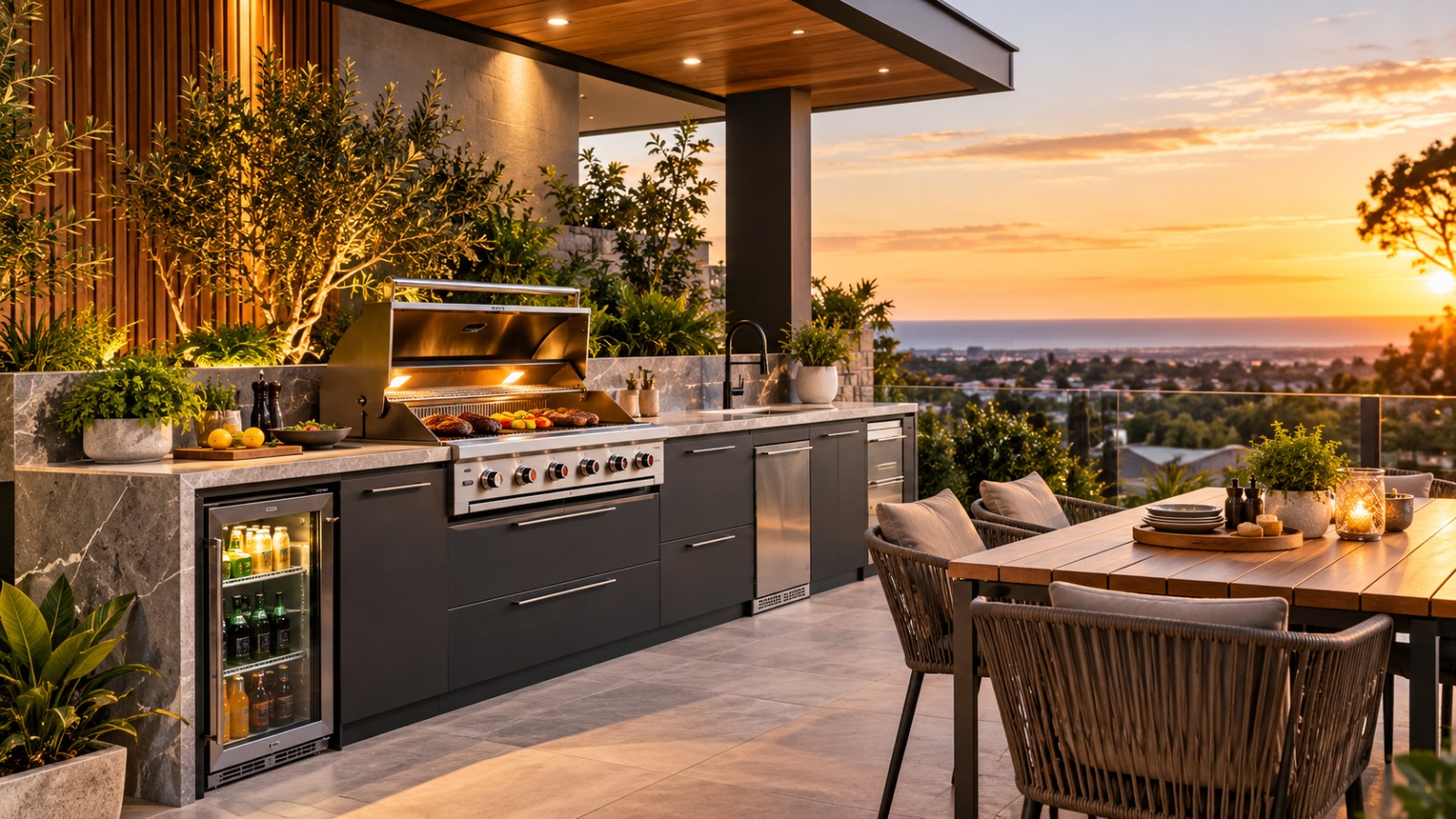
The best outdoor kitchens are not necessarily the biggest or the most expensive. They are the ones you actually use.
For Australian homeowners, that increasingly means designing an alfresco kitchen that works beyond summer weekends. A well-planned space should make it easy to cook on a hot January evening, entertain when the temperature drops, keep food and drinks close to guests, and protect cabinetry and appliances from changing weather.
That is why the modern outdoor BBQ kitchen is evolving from a barbecue installed beside a bench into a genuine extension of the home.
The key is to plan around four things before choosing finishes or appliances: how you entertain, where you cook, how the area handles weather, and how people move through the space.
For Adelaide homeowners in particular, this matters because the region has a Mediterranean climate with warm to hot, dry summers and wetter, cooler winters. An outdoor space designed only for perfect summer weather leaves a lot of potential unused.
Start with how you actually entertain
It is easy to design an outdoor kitchen around appliances. A better approach is to design around people.
Think about what happens when friends or family visit. Does everyone gather around the BBQ? Do you usually serve food buffet-style? Are drinks constantly being brought outside from the indoor fridge? Does the person cooking end up separated from everyone else?
These questions should determine the layout.
If entertaining is the priority, the BBQ should normally remain connected to the social area rather than being pushed into an isolated corner. Preparation space should sit close to the cooking zone, while drinks, serving areas and frequently used storage should be accessible without people continually walking through the cook's working area.
A practical outdoor kitchen generally needs three functional zones:
- Cooking
- Preparation
- Serving and entertaining
They do not have to be large. They simply need to connect logically.
This is also why integrated outdoor kitchens are becoming more popular. Australian homeowners increasingly want alfresco spaces that function as additional living areas rather than separate backyard features.
Build the BBQ into the design, rather than designing around it later
For many homeowners, the BBQ is the starting point. But choosing the BBQ first without considering the surrounding kitchen can create awkward gaps, limited preparation space and poor storage.
Instead, decide what type of cooking you genuinely do. Someone who mainly grills steaks and vegetables has different requirements from someone who regularly cooks for 15 people, uses a rotisserie, wants a pizza oven or prefers several cooking surfaces.
A built-in outdoor BBQ kitchen works best when the appliance, benchtop, cabinetry and storage are treated as one system.
Leave useful bench space close to the barbecue. Include somewhere to place raw ingredients before cooking and somewhere separate for finished food. Then consider what you repeatedly carry between the indoor and outdoor kitchen.
If the answer is drinks, utensils, plates, sauces and serving equipment, those are the items worth providing storage for outside.
Haute Alfresco offers both pre-designed and custom outdoor-kitchen configurations, with BBQ integrations and outdoor-ready cabinetry and benchtop options designed around practical alfresco use.
Design for twelve months, not three
The difference between a frequently used alfresco kitchen and an occasionally used one often has little to do with the barbecue. It is usually the environment around it.
Summer sun, winter rain, wind, insufficient lighting and uncomfortable seating can make even an expensive outdoor kitchen inconvenient.
A covered alfresco area can substantially extend how often the kitchen is usable. Weather protection, task lighting and durable materials should be considered before the kitchen is manufactured, not after installation.
The important point is that weather protection should be considered before the kitchen is manufactured, not after installation.
| Condition | Design consideration |
|---|---|
| Hot summer afternoons | Shade over preparation, cooking and seating areas |
| Winter rain | Covered cooking and serving areas |
| Evening entertaining | Dedicated task lighting over BBQ and benches |
| Wind | Appliance placement and protected preparation areas |
| Coastal environments | Materials and hardware suitable for moisture and salt exposure |
| Year-round storage | Outdoor-suitable cabinetry rather than indoor materials used outside |
Choose materials for the environment, not just the showroom
An outdoor kitchen lives a harder life than an indoor one. UV exposure, temperature changes, rain, moisture, grease and general outdoor dust all affect finishes differently over time.
That means a material that looks attractive indoors is not automatically appropriate outside.
For cabinetry, ask whether the construction is genuinely designed for outdoor exposure rather than simply described as moisture resistant. For benchtops, consider heat exposure, sunlight, staining, cleaning and whether the material is suitable for the installation location.
Hardware matters as well. Hinges, runners and fittings are easy to overlook during the design process but are used constantly once the kitchen is installed.
Haute Alfresco highlights waterproof cabinetry construction, stone benchtops, Australian-made kitchens and a 10-year warranty across its current offering, which are useful points to compare when evaluating an outdoor-kitchen specification.
Don't underestimate preparation space
One of the most common mistakes in an outdoor kitchen is allocating almost everything to appliances.
A large barbecue, sink and fridge might look impressive on a plan, but if only a narrow strip of bench remains, cooking becomes frustrating.
You need somewhere to prepare ingredients, place trays, season food, rest cooked food and serve guests.
For smaller alfresco areas, it can actually be better to choose a slightly more compact barbecue and preserve usable worktop space.
So when comparing layouts, do not ask only: “How many appliances can we fit?” Ask: “How easily could two people prepare and serve dinner here?” That usually produces a better kitchen.
Think carefully about refrigeration and sinks
A bar fridge can make an outdoor kitchen dramatically more convenient because it reduces trips back inside. But it needs to be appropriate for the intended location and installed according to the manufacturer’s requirements.
A sink can be equally useful when the kitchen is regularly used for preparation and cleaning, but it adds plumbing requirements and installation cost.
Neither appliance should automatically be considered essential. For some households, BBQ + generous preparation space + storage + refrigeration may provide more day-to-day value than filling every available cabinet with appliances.
Design around behaviour, not a checklist.
Covered BBQ areas need proper ventilation
This is particularly important in South Australia. If you are planning a gas barbecue underneath a verandah or within a partially enclosed alfresco area, ventilation cannot be treated purely as a design preference.
Outdoor gas appliances used within partially enclosed spaces need sufficient permanent openness to the outside. The exact requirements depend on how many sides of the structure are open.
Fixed or built-in barbecues should be installed in accordance with applicable gas-safety requirements by a suitably licensed professional. This is something to resolve during the design stage, because moving an appliance or modifying an enclosure after manufacture can be far more difficult than planning correctly from the beginning.
Make the kitchen part of the home
One of the strongest current outdoor-living trends is visual continuity between indoor and outdoor spaces. That does not mean both kitchens need to look identical. It means they should feel related.
If the indoor kitchen opens directly onto the alfresco area, consider repeating elements such as colour tones, benchtop character, cabinetry style or architectural lines. The result feels less like “a BBQ outside” and more like another room of the home.
Haute Alfresco’s range reflects this approach through multiple design collections, colour choices, stone benchtops and custom configurations rather than a single one-size-fits-all outdoor BBQ setup.
Plan storage around what you want to leave outside
Outdoor-kitchen storage should make the space easier to use. Before deciding how many cupboards and drawers you need, make a simple inventory of what you would realistically store outside.
- BBQ utensils
- Serving trays
- Chopping boards
- Cleaning supplies
- Plates and glasses
- Condiments and cooking accessories
Items used most frequently should be closest to their point of use. Cooking utensils belong near the BBQ. Preparation equipment belongs below the preparation bench. Serving items belong closer to the entertaining side.
This seems obvious, but designing cabinetry around real tasks can make a compact kitchen feel significantly more functional than a larger kitchen with poorly positioned storage.
What should you prioritise if space or budget is limited?
Start with the elements that improve how often you will use the space. A good BBQ, adequate preparation space, durable cabinetry and protection from weather will generally matter more than filling the kitchen with secondary appliances.
You can then add refrigeration, sinks, specialised cooking appliances and extra storage according to your lifestyle.
A smaller but carefully planned outdoor BBQ kitchen will usually perform better than a larger layout in which every appliance has been included simply because there was room for it.
A practical layout example
Imagine a family in Adelaide with a covered 4.5-metre alfresco wall.
Rather than filling the entire wall with appliances, the design might place storage at one end, a generous preparation zone beside the BBQ, the built-in BBQ in the central cooking area and an outdoor fridge closer to the dining side.
The cook remains connected to guests. Drinks can be accessed without entering the cooking zone. There is enough bench space to prepare and serve food. And because the kitchen sits under an appropriately designed covered area, it can be useful well beyond summer.
That is the difference between selecting outdoor-kitchen components and actually designing an outdoor lifestyle space.
Frequently asked questions
What should an outdoor BBQ kitchen include?
At minimum, most homeowners need a suitable BBQ, preparation space and outdoor-ready storage. Refrigeration, sinks, additional burners, pizza ovens and other appliances should be added according to how you cook rather than automatically included.
How much bench space do I need beside a BBQ?
There is no single measurement that works for every kitchen. What matters is preserving enough uninterrupted preparation and serving space rather than allowing appliances to consume the entire benchtop. Consider the size of trays, chopping boards and dishes you normally use when planning the layout.
Can an outdoor kitchen be used throughout winter?
Yes, provided the overall alfresco environment has been designed appropriately. Weather protection, lighting, wind exposure and comfortable dining areas often influence year-round usability as much as the kitchen itself.
Can I install a BBQ under a covered alfresco area?
Potentially, but gas appliances require appropriate ventilation and installation conditions. Covered or partially enclosed areas should be assessed against applicable gas-safety and ventilation requirements before installation.
Is a custom outdoor kitchen better than a pre-designed one?
Neither is automatically better. Pre-designed kitchens can provide a simpler starting point when the dimensions and requirements suit the space. Custom designs become useful when dimensions, appliance choices, storage needs or architectural requirements are more specific. Haute Alfresco offers both approaches.
Design around the way you’ll live outdoors
The outdoor kitchens that age well are rarely the ones with the longest appliance list. They are the ones where cooking feels natural, guests can gather comfortably, materials suit the environment and the space remains useful across different seasons.
Before deciding what your outdoor BBQ kitchen should look like, decide how you want it to work.
- Where will people gather?
- What do you cook most often?
- What will stay outside?
- When during the year do you want to use the space?
Answer those questions first, and decisions about layout, BBQs, storage and finishes become much easier.
Haute Alfresco designs both pre-configured and custom outdoor kitchens for Adelaide homes, with showroom options where homeowners can compare layouts, materials and appliance choices in person.